A 5000W pure sine wave inverter runs a small home or an off-grid cabin: fridge, lights, TV, washing machine, water pump and air conditioner in combinations under 5000W, with 10000W of surge power for motor start-up. It is the largest model in Sunrise New Energy (Powsmart)’s REP pure sine wave range — the point where an inverter stops being a single-appliance tool and starts covering a whole small household. This guide explains what it runs, how it differs from a 3000W model, and how to size one.
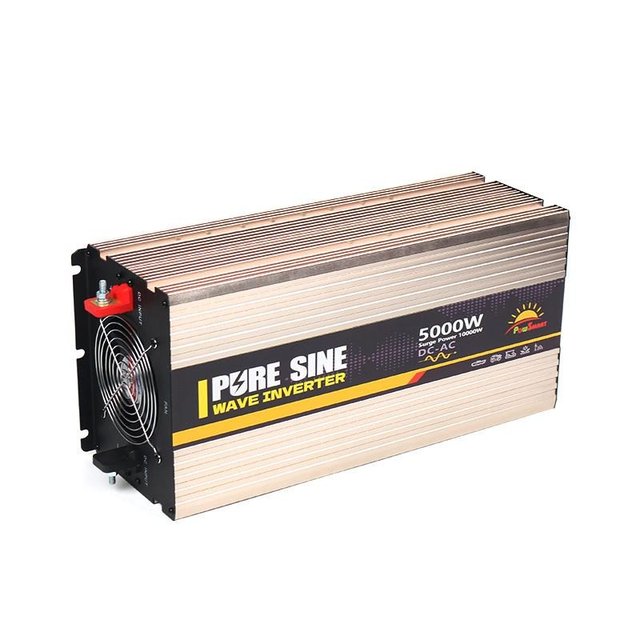
The product page puts it simply: a small home or off-grid cabin — fridge, lights, TV, washing machine, water pump and air conditioner, in combinations under 5000W. The key word is combinations: several ordinary appliances running at the same time, which is how a small household uses power in the evening.
The 10000W surge rating is what makes those combinations work: motors — fridge compressors, water pumps, air conditioner compressors — draw a short burst of extra power when they start, and the surge rating absorbs it so the inverter does not trip while other loads are already running.
The output is a pure sine wave with THD below 3% under linear load — the same quality as household mains. That matters for sensitive loads: laptops, TVs and medical devices run on clean power, without the buzzing or overheating a modified sine wave can cause.
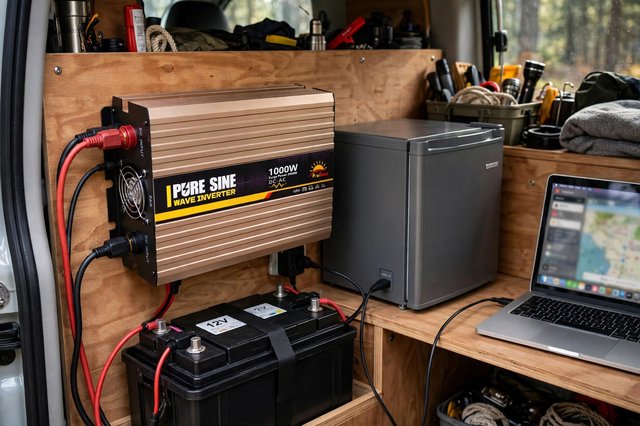
Stepping from 3000W to 5000W adds 2000W continuous and 4000W surge: 3000W rated with 6000W peak, against 5000W rated with 10000W peak. In practice, 3000W covers one large load at a time — a microwave, a washing machine, or a fridge plus lights and a laptop — the right size when your loads take turns. We sized that model in our 3000W pure sine wave inverter guide.
5000W is the size for loads that overlap. If the fridge, TV and lights are already on and you still want to run the washing machine or the air conditioner, that is a 5000W job. Add up the loads that run together: if the total regularly passes 3000W, step up; if it stays well under, the smaller model does the same job with less battery drain and lighter cabling.
How to Size a 5000W Inverter for Your LoadsSizing is a short calculation, not a guess. Work through it in this order:
1. List every load you will run at the same time, with its rated watts from its nameplate.
2. Add them up. The simultaneous total must stay under 5000W.
3. Check motor start-up: allow two to three times the running watts for compressors, pumps and power tools as they start, and keep that peak under 10000W.
4. Leave headroom: an inverter at its limit all evening runs hot and leaves no room for a motor to start, so keep your normal total comfortably below 5000W.
In a small cabin in the evening, a fridge draws about 100–150W while running, so fridge, lights, TV, washing machine and water pump together usually sit far below the ceiling. It is the air conditioner and overlapping motor starts that push the total up — that is the calculation that decides between 3000W and 5000W, not any single appliance. And do not size from the surge rating: 10000W is short-term starting capacity, not continuous output.
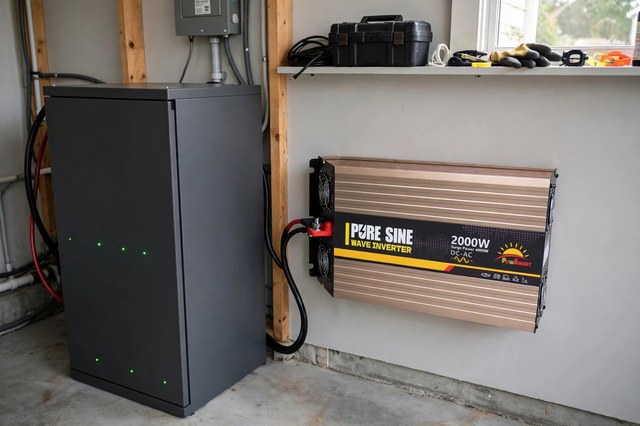
The REP5000 comes in 12V, 24V and 48V versions. If you already have a battery system, match it. For a new solar or backup installation, 24V or 48V is usually better — and at 5000W the reason is current, not convenience.
At full load, a 12V battery has to deliver roughly 463A — a very heavy current that needs thick cables and solid terminations. A 48V system delivers the same power at about a quarter of that current, with higher efficiency and cooler cables. Maximum efficiency is 90% at 12V, 92% at 24V and 95% at 48V.
Wire size and fuse ratings follow from the version you choose, so check the manual for the exact sizes. Voltage platform is a system decision: battery, inverter and cabling are sized together.
Protection Values Worth KnowingThe REP5000 protects itself and the battery with staged voltage limits (product page parameter table; 12V, 24V and 48V in that order).
| 12V | 24V | 48V | |
|---|---|---|---|
| Low-voltage alarm | 10.5±0.5V | 21±0.5V | 42±1V |
| Low-voltage protection (shutdown) | 10±0.5V | 20±0.5V | 40±0.5V |
| Low-voltage recovery | 12.3±0.5V | 24±0.5V | 48±1V |
| Over-voltage protection | 15.5±0.5V | 31±0.5V | 61±1V |
| Over-voltage recovery | 14.8±0.5V | 29.5±0.5V | 59±1V |
| Input voltage range | 10–15.5V | 20–31V | 40–61V |
| No-load current, less than | 1.2A | 0.8A | 0.5A |
Note the 48V column: only the low-voltage protection is ±0.5V; the other limits are ±1V. Protection also covers over load, over temperature, short circuit and reverse polarity (fuse). Working temperature is -10°C to 50°C with intelligent air cooling.
What a 5000W Inverter Does Not DoThis is an inverter only — it converts DC to AC and does not charge the battery. If you need mains charging in the same unit, look at the inverter-with-charger (UPS) models instead.
Check the USB port before ordering: the 12V and 24V versions have a QC3.0 USB port; the 48V version does not. Custom orders can change shell colour and branding, with EU, USA, Japan, UK, Australia or universal sockets, and DC inputs of 36V, 60V, 72V, 84V or 96V on request. The unit weighs 8.54kg net (11kg gross) and ships one per carton.
Frequently Asked QuestionsYes, as part of a combination under 5000W — the product page lists an air conditioner among the loads a small home or off-grid cabin can run, with the 10000W surge covering the compressor’s start-up. Check its rated and starting watts first.
For a small home or an off-grid cabin, yes. It is not a whole-house solution for a large home with electric cooking and heating running at once — add up your simultaneous loads and compare them with 5000W continuous and 10000W surge.
Match the battery system you already have. For a new installation at 5000W, 24V or 48V is usually better: 12V draws roughly 463A at full load, 48V about a quarter of that, with higher efficiency and cooler cables.
No. It is an inverter only. If you need mains charging in the same unit, ask about the inverter-with-charger (UPS) models.
Follow the manual for your voltage version and installation: wire and fuse sizes depend on the current your version draws, so the manual’s table — not a generic chart — is the reference.
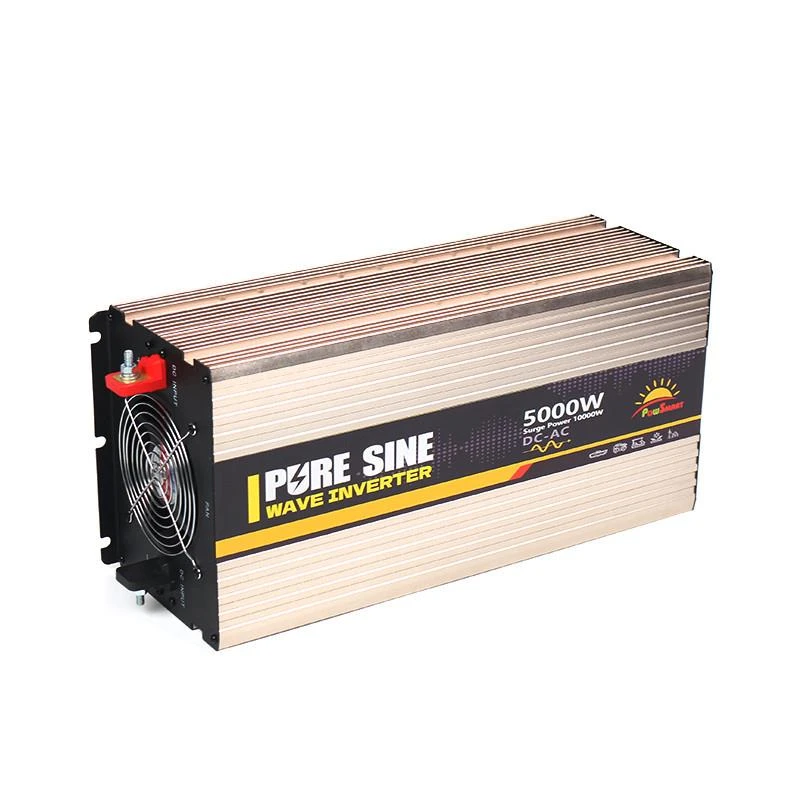
Sizing a system for a small home, a cabin or a work site? Send Sunrise New Energy your load list — the appliances you will run at the same time, and your battery voltage — and we will confirm whether the 5000W model is the right size. Zhejiang Sunrise New Energy Co., Ltd. supplies the REP pure sine wave inverter range from 300W to 5000W, in 12V, 24V and 48V versions.

We use cookies to enhance your browsing experience, serve personalized ads or content, and analyze our traffic. By clicking "Accept All", you consent to our use of cookies.