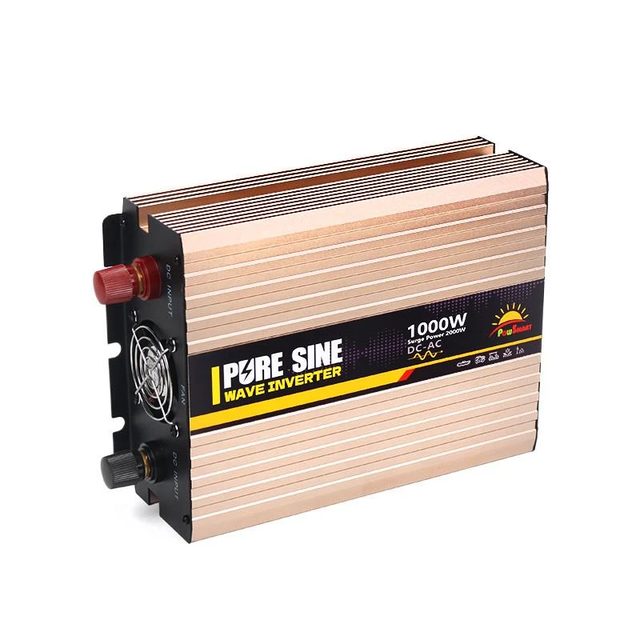
Choose a 12V inverter if your vehicle has a standard 12V electrical system, which covers almost all cars, SUVs and pickups, and choose a 24V inverter only if your vehicle or battery bank is actually wired for 24V, as on many heavy trucks and some off-grid setups. The inverter's input voltage must match your battery voltage exactly — this is not a preference you can swap. This guide from Zhejiang Sunrise New Energy Co., Ltd. explains how to check your system, why voltage changes cable size and cost, and which option suits each power level.
How Do You Know If Your Vehicle Is 12V or 24V?Most passenger cars, SUVs, minivans and light pickups are 12V; many heavy trucks, buses and military or commercial vehicles are 24V. Three quick checks settle it: read the battery label (a single 12V battery in a car almost always means a 12V system); see how two batteries are linked (positive-to-negative in series makes 24V, positive-to-positive in parallel stays 12V with double capacity); and check the manual or charging voltage (about 14V charging means 12V, about 28V means 24V). Never guess from vehicle size alone — some large diesel pickups use two batteries in parallel and are still 12V. Measure if unsure.
What Actually Changes Between 12V and 24V?Both inverters produce the same household AC output. The difference is on the DC side: for the same watts, a 24V system draws half the current of a 12V system.
DC amps ≈ inverter watts ÷ battery volts ÷ 0.85 efficiency. That one formula drives everything else:
| Inverter size | DC current at 12V | DC current at 24V |
|---|---|---|
| 500W | about 49A | about 25A |
| 1000W | about 98A | about 49A |
| 2000W | about 196A | about 98A |
| 3000W | about 294A | about 147A |
Lower current means thinner, cheaper cables, less voltage drop, less heat at the terminals, and fewer nuisance low-voltage shutdowns. That is the whole practical argument for 24V — not more power, but the same power delivered with half the current.

For loads under about 1000W, 12V is simple and perfectly adequate. Phones, laptops, cameras, a small TV and LED lights draw modest current, cable runs in a car are short, and small plug-in or directly wired 12V inverters are widely available.
Between 1000W and 2000W, 12V still works, but installation quality decides success. Currents pass 100A, so cables must be short, thick copper with properly crimped lugs and a fuse at the battery. Most car and RV systems in this range stay 12V because that is what the vehicle provides — the answer is better wiring, not a different voltage.
Above 2000W, 24V becomes clearly easier to live with. At 3000W a 12V inverter pulls close to 300A, which demands very heavy cable and flawless connections. The same load at 24V needs about half that current. This is why heavy trucks with 24V systems run large sleeper-cab inverters comfortably, and why serious off-grid battery banks often move to 24V or higher.
The rule is simple: you do not choose voltage freely — your vehicle chooses it for you, and you size the wiring honestly for the current that follows.
Can You Use a 12V Inverter on a 24V System, or the Other Way Round?No. A 12V inverter connected to 24V will be damaged by over-voltage, and a 24V inverter on 12V will refuse to run or shut down on low voltage. Both mistakes are common online purchases, so check the input rating on the label before ordering.
Two related traps deserve care:
If your vehicle is 24V, buy a native 24V inverter. If it is 12V, buy a native 12V inverter. Matching the native voltage is always cheaper and safer than adapting.
What If You Are Building an Auxiliary Battery System?Drivers who want serious power without touching the starter battery often add a separate auxiliary (house) battery. Here you do have a choice: keep the auxiliary bank at the vehicle voltage — 12V for most cars — so it can charge from the alternator through a DC-DC charger or isolator; choose 24V only if the auxiliary system is standalone, charged by solar or mains, and never directly mixed with a 12V starter circuit. For most car, SUV and camper builds, a 12V auxiliary battery with a pure sine wave inverter is the most flexible, lowest-risk design.

Voltage and waveform are separate decisions. Whichever voltage you use, choose pure sine wave output for anything beyond a simple charger. It matches household power, so laptop adapters, TVs, fridge compressors and CPAP machines run correctly and quietly, while modified sine wave can make motors run hot and fans buzz. For a permanently installed vehicle system, pure sine wave is the safe default at 12V and 24V alike.
Is a 24V inverter more powerful than a 12V inverter?
Not by itself. A 2000W inverter delivers 2000W at either voltage. 24V simply delivers that power at half the DC current, which makes cabling easier at large sizes.
Can I run a 3000W inverter in a normal car?
It is rarely practical. A 12V car system would need close to 300A, extremely heavy cable and a battery bank far larger than a starter battery. Most cars are happiest at 2000W or below, wired directly to the battery with a fuse.
My truck has two batteries. Is it 12V or 24V?
It depends on the wiring, not the count. Series connection (positive to negative between batteries) means 24V; parallel connection (positive to positive) means 12V with more capacity. Check the cables or measure the voltage across the pair.
Will a 24V inverter charge from my 12V car?
No — a 24V inverter is only the load side. Its battery bank must be a real 24V bank with a matching 24V charging source. Never connect a 24V bank directly to a 12V alternator system.
Match the Voltage, Then Size the PowerThe decision takes one minute: confirm your vehicle's actual system voltage, buy an inverter with exactly that input voltage, then size the watts for your appliances and the cables for the current. Get those three right and either system will run reliably for years.
Zhejiang Sunrise New Energy Co., Ltd. designs and manufactures pure sine wave inverters, inverter-chargers (UPS) and solar hybrid inverters for cars, trucks, RVs and off-grid homes. Tell us your vehicle voltage and the appliances you want to run, and we will recommend the right model and size. Visit cninverter.com or contact us: WhatsApp 86 17706649699, email Long@cninverter.com.

We use cookies to enhance your browsing experience, serve personalized ads or content, and analyze our traffic. By clicking "Accept All", you consent to our use of cookies.