A 4000W pure sine wave inverter is the entry point for whole-home power. Rated 4000W continuous with 8000W of peak power, it runs the core circuits of a small home or cabin — fridge, lights, TV, washing machine, a water pump or a small air conditioner — in combinations under 4000W. If 3000W strains on two motor loads at once and 5000W feels oversized, 4000W is the answer.
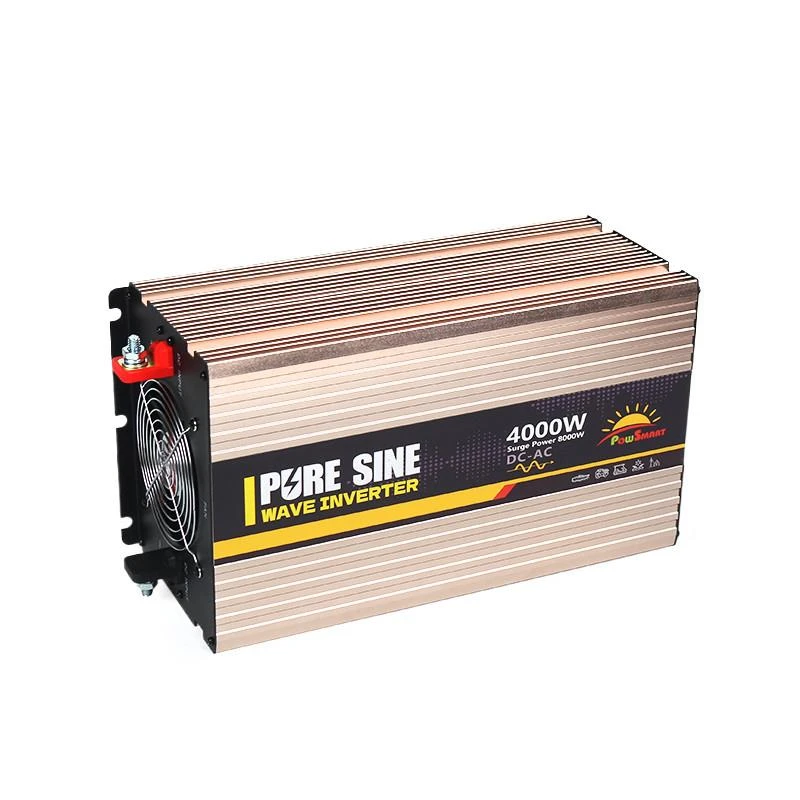
Sunrise New Energy (Powsmart) builds the REP4000 in 12V, 24V and 48V versions, with pure sine wave output and total harmonic distortion below 3% under linear load.
What a 4000W Inverter RunsThe product page lists: a fridge, lights, a TV, a washing machine, a water pump or a small air conditioner, in combinations under 4000W of running power. The point is the combination — this is a small-home power centre, not a single-appliance tool.
A running fridge draws about 100–150W, a TV 60–150W, LED lights 10–30W and a laptop 45–90W, so that everyday set leaves plenty of headroom. A washing machine draws roughly 500W while running, with a higher surge when its motor starts; a small air conditioner draws roughly 800–1200W while running, again with a starting surge. Add the two together with the fridge and the lights, and the running total is around 1500–2000W — well inside 4000W — while the 8000W peak covers the motor starts. A water pump follows the same rule: modest running watts, but two to three times that for a second or two at startup.
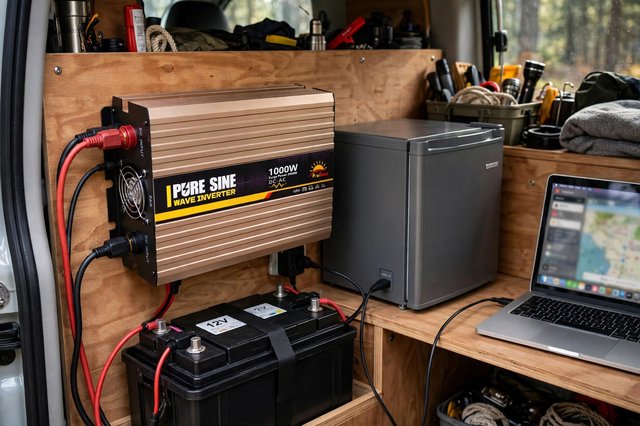
Pick by the list, not by the number on the box.
The 3000W model (6000W peak) covers a fridge, TV, lights and laptop with a 1000–1200W microwave, and a washing machine or a small air conditioner on its own. Choose it when the list is one big motor load at a time. We sized that model in our 3000W pure sine wave inverter guide.
The 4000W model (8000W peak) adds the combination: a washing machine and a small air conditioner together, or a water pump alongside the everyday set. Choose it when two motor loads may run at the same time.
The 5000W model (10000W peak) is the whole small-house step — choose it when the list keeps growing past 4000W. At 12V, full-load current is about 278A, 370A and 463A for 3000W, 4000W and 5000W — so use short, thick DC cables and a fuse sized to the manual. See our 5000W pure sine wave inverter guide for the top of the range.
How to Size an Inverter in Three StepsFirst, list every load you want to run at the same time, with its running watts from the label. Second, add a starting surge for motors — fridges, compressors, washing machines, pumps and air conditioners draw two to three times their running watts for a second or two at startup. Third, compare the total against the rated power, not the peak: 8000W covers starting surges; 4000W is what the inverter delivers continuously. If the running total tops 4000W, or one surge tops 8000W, step up a size.
12V, 24V or 48V: Which Version?Match the battery system you already have. For a new solar or backup installation, 24V or 48V is usually better: at 4000W a 12V battery must deliver roughly 370A, while 48V delivers the same power at about a quarter of that current.
Higher voltage also means thinner DC cables and less voltage drop. Efficiency is 90% on 12V, 92% on 24V and 95% on 48V. Output is 100/110/120VAC or 220/230/240VAC at 50Hz or 60Hz (±0.5Hz) — order the version for your market.
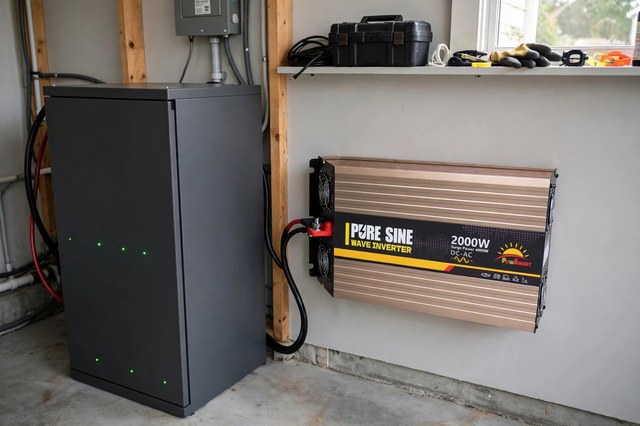
The REP4000 protects the battery with voltage cut-offs that differ by version. On 48V, only the low-voltage protection is ±0.5V; the rest are ±1V.
| 12V | 24V | 48V | |
|---|---|---|---|
| Low-voltage alarm | 10.5±0.5V | 21±0.5V | 42±1V |
| Low-voltage protection (shutdown) | 10±0.5V | 20±0.5V | 40±0.5V |
| Low-voltage recovery | 12.3±0.5V | 24±0.5V | 48±1V |
| Over-voltage protection | 15.5±0.5V | 31±0.5V | 61±1V |
| Over-voltage recovery | 14.8±0.5V | 29.5±0.5V | 59±1V |
Input range is 10–15.5V, 20–31V and 40–61V; working temperature is -10°C to 50°C; no-load current is under 1A, 0.7A and 0.4A on 12V, 24V and 48V. Wire size, fuse rating and battery capacity follow the manual.
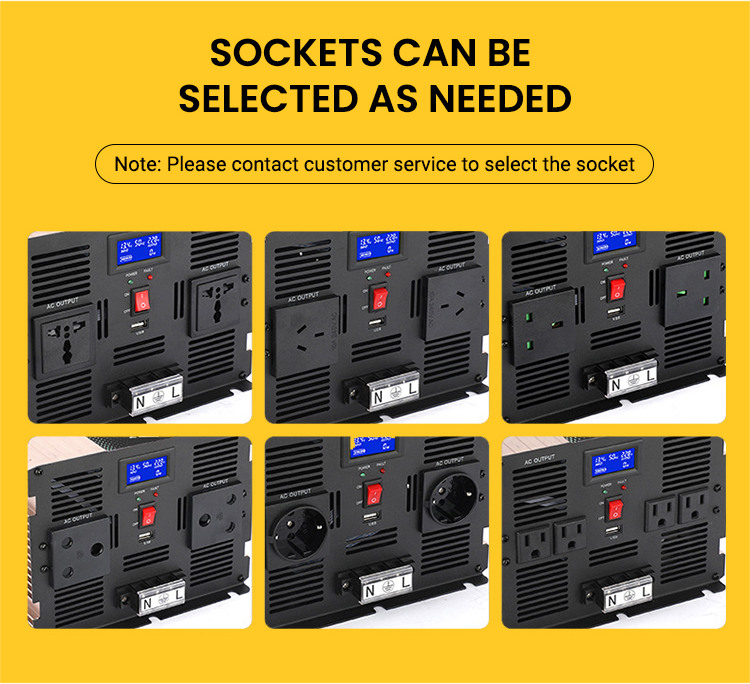
The 12V and 24V versions have a USB 3.0 port; the 48V version has none.
At 6.82kg net (8.5kg gross, one per carton), the REP4000 suits a fixed cabin or small-home installation; shell colour, branding, sockets and DC input can be customised on OEM/ODM orders. See the full REP pure sine wave inverter range for the other sizes.
Installation Notes: Airflow and PlacementA 4000W inverter makes heat doing its job. The REP4000 uses smart fan cooling and is rated from -10 to 50°C, but the rating assumes air can move: mount it where air flows freely, keep the fan vents clear, and do not box it into a sealed cupboard. Keep DC cables short, especially on 12V, where roughly 370A at full load makes every extra metre cost voltage.
What a 4000W Inverter Cannot DoTwo limits. This is an inverter only — it converts DC to AC and does not charge the battery; for mains charging, ask about the inverter-with-charger (UPS) models. And it is not a large-house backup unit: it covers the core circuits of a small home or cabin.
Frequently Asked QuestionsYes. A washing machine at about 500W plus a small air conditioner at about 800–1200W, with a fridge and lights, totals around 1500–2000W — inside 4000W, with the 8000W peak covering starts.
Match the battery system you have. For a new installation, 24V or 48V is usually better — at 4000W, 12V means roughly 370A, while 48V needs about a quarter of that current.
It warns first, then cuts off. On 48V the alarm sounds at 42 ± 1V, cut-off is at 40 ± 0.5V and it restarts at 48 ± 1V — the same staged protection applies on 12V and 24V.
No charging — this is an inverter only; ask about the UPS models with a built-in charger. The USB 3.0 port is on the 12V and 24V versions only; the 48V version has none.
For the core circuits, yes — fridge, lights, TV, washing machine, water pump or a small air conditioner under 4000W combined. Electric cooking or heating needs a bigger system.
A 4000W pure sine wave inverter fits when the load list is one step past 3000W — a washing machine and a small air conditioner together in a small home or cabin. Size from the load list, let the 8000W peak cover motor starts, and pick the voltage that matches your battery.
Still choosing between 3000W, 4000W and 5000W? Send Sunrise New Energy (Powsmart) your load list — loads, battery voltage, cabin or small home — and we will help you pick the size that fits.

We use cookies to enhance your browsing experience, serve personalized ads or content, and analyze our traffic. By clicking "Accept All", you consent to our use of cookies.