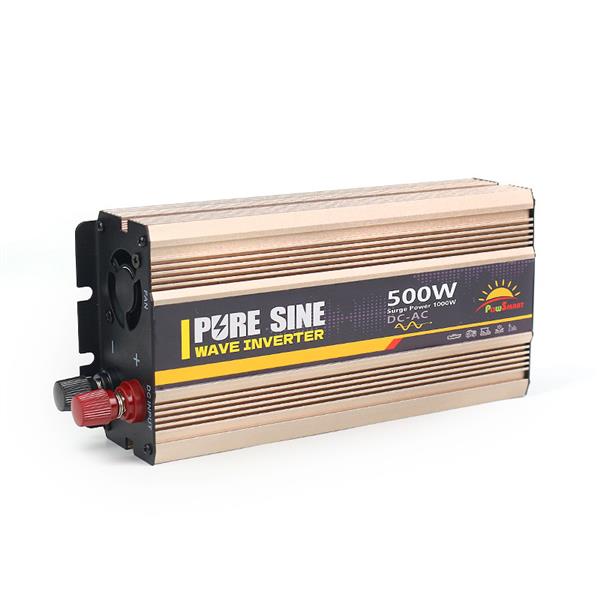
A 500W pure sine wave inverter runs LED lights, a TV, a laptop, a fan and phone charging at the same time, with 1000W of peak power for short surges. The REP500 from Sunrise New Energy (Powsmart) is the entry point of the REP pure sine wave range: big enough for lights and screens, small enough to stay light and easy to wire. The mistake is expecting a 500W box to do a 1500W job. This guide shows what it runs, where its limit sits, and how to size one.
What a 500W Inverter RunsThe product page puts it plainly: a 500W inverter runs LED lights, a TV, a laptop, a fan and phone charging together, or one small appliance at a time. Typical running watts show why they fit:
| Load | Typical running watts |
|---|---|
| LED lights (a roomful) | 10–20W |
| TV (32–43 inch) | 60–120W |
| Laptop (charging and running) | 45–90W |
| Fan | 30–60W |
| Phone charging | 5–15W |
| Typical combination total | About 150–300W |
A combined load of roughly 150–300W sits comfortably below the 500W rated output, leaving headroom for switch-on surges. Note that the 1000W peak rating is short surge capacity, not continuous output: it covers the brief inrush at startup, then the inverter must settle back under 500W. Pure sine wave output, with THD below 3% under linear load, is as clean as household mains.
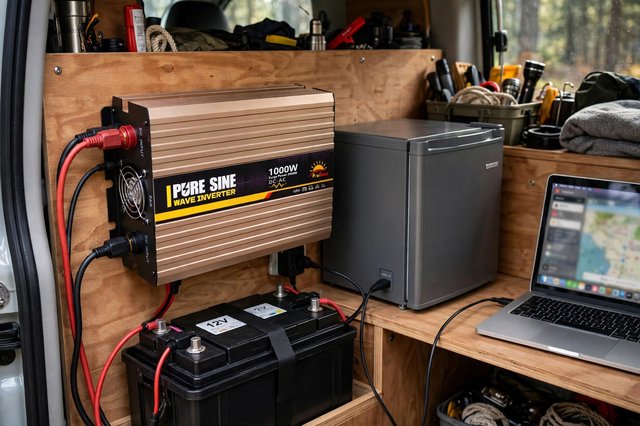
The product page is equally clear about the other side: heating appliances such as kettles are beyond this size. A kettle, a heater, a hair dryer or a water heater typically draws 1000W or more — double the rated output or beyond the peak. Plugging one in trips the overload protection: the red LED comes on and the unit shuts down. If the appliance turns electricity into heat, check its nameplate — if it is rated above 500W, this is the wrong size. A microwave is in the same group, usually needing 800W or more.
500W vs 600W: Where the Line SitsThe next model up, the 600W inverter, is only 100W bigger on paper, but the line between the two is real. The 500W ceiling is lights, TV, laptop, fan and phone charging together; the 600W model adds one thing — a small rice cooker, on its own, as a single load.
Both share the same limit: neither will run a kettle or any heating appliance, so if your list includes anything that heats, step up well past 600W. If your list is lights and screens, 500W does the job at a lower weight and draw on the battery — 1080g net. Read the next size up in 600W Pure Sine Wave Inverter: What It Runs, How to Size.
How to Size a 500W Inverter in Three StepsStep 1: list every load you will run at once. Write down each appliance's rated watts from its nameplate and add them up, counting only loads that run at the same time — a TV plus a laptop plus lights is a realistic evening load; a TV plus a kettle is not a 500W load.
Step 2: leave room for startup surges. Motor-driven loads draw several times their running watts for a second or two at startup. Keep the total under 500W and any single surge under the 1000W peak — if one surge alone is close to 1000W, pick a bigger inverter.
Step 3: check the battery side, not just the AC side. 500W on the AC side means real current on the DC side: on a 12V battery the inverter draws about 46A at full load, so cables, fuse and battery must be sized for that. Wire size and fuse rating must follow the manual.
12V, 24V or 48V: Which One?The REP500 comes in 12V, 24V and 48V versions; the product page advice is to match the battery system you already have. For a new solar or backup installation, 24V or 48V is usually better: at 500W a 12V battery has to deliver roughly 46A, while a 48V system delivers the same power at about a quarter of that current, with higher efficiency and cooler cables — 90% on 12V, 92% on 24V and 95% on 48V. On an existing 12V vehicle system, the 12V version is the right call: matching the battery you have beats rewiring the vehicle.
The figures below are from the REP500 product page parameter table, verified on 2026-11-29. Only the low-voltage protection value is ±0.5V on the 48V version — the alarm, recovery and over-voltage values are ±1V.
| Specification | 12V | 24V | 48V |
|---|---|---|---|
| Rated power | 500W | ||
| Peak power | 1000W | ||
| Output waveform | Pure sine wave, THD <3% (linear load) | ||
| Max. efficiency | 90% | 92% | 95% |
| Input voltage range | 10–15.5V | 20–31V | 40–61V |
| Low-voltage alarm | 10.5±0.5V | 21±0.5V | 42±1V |
| Low-voltage protection | 10±0.5V | 20±0.5V | 40±0.5V |
| Low-voltage recovery | 13±0.5V | 24±0.5V | 48±1V |
| Over-voltage protection | 15.5±0.5V | 31±0.5V | 61±1V |
| Over-voltage recovery | 14.8±0.5V | 29.5±0.5V | 59±1V |
| No-load current | <0.4A | <0.2A | <0.2A |
| USB port | 5V 1A | ||
| Working temperature | -10 to 50°C | ||
| Warranty | 2 years | ||
Protection works in stages: the inverter alarms first on low voltage, then shuts down with the red LED on if the voltage keeps falling. Over-voltage, overload and over-temperature shut it down the same way; a short circuit lights the red LED, and reverse polarity blows the fuse. The USB port supplies 5V 1A for phone charging. This is an inverter only — it does not charge the battery; for mains charging in the same unit, look at the inverter-with-charger (UPS) models.

Maybe — check the nameplate. A small fridge's running watts may fit, but the compressor's startup surge can be several times higher. If that surge stays under the 1000W peak it can work; if not, the inverter shuts down. When in doubt, size up to the 1000W model.
No. Kettles and other heating appliances draw more than 500W. A small rice cooker on its own needs the 600W model; a kettle needs a much bigger inverter, usually 1000W or more.
No — it is an inverter only, converting DC to AC. If you need mains charging in the same unit, ask about the inverter-with-charger (UPS) models.
Match the battery system you already have; for a new solar or backup installation, 24V or 48V is usually better.
Yes. OEM/ODM orders can customise shell colour and branding, with EU, USA, Japan, UK, Australia and universal sockets available and custom DC input voltages on request.
Bottom line: a 500W pure sine wave inverter is the right size when your load list is lights, screens and small electronics — LED lights, a TV, a laptop, a fan and phone charging together. Add up your loads, keep the total under 500W rated and any startup surge under 1000W peak, and match the voltage to your battery. If a kettle or a rice cooker is on the list, step up a size. Browse the full REP pure sine wave inverter series from Sunrise New Energy (Powsmart), 300W to 5000W in 12V, 24V and 48V, or see the REP500 product page and contact us for sizing help.

We use cookies to enhance your browsing experience, serve personalized ads or content, and analyze our traffic. By clicking "Accept All", you consent to our use of cookies.