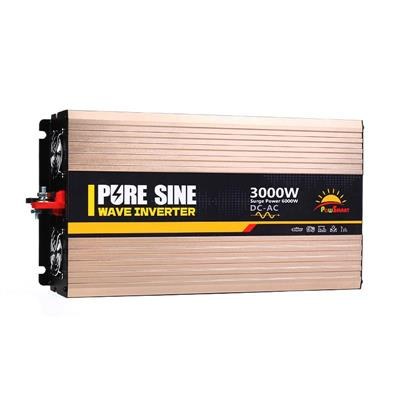
A 3000W pure sine wave inverter runs a fridge, TV, lights and a laptop together, or a 1000–1200W microwave on its own, with 6000W of peak power for motor start-up. This guide explains what the Sunrise New Energy (Powsmart) REP3000 can and cannot run, and how to size one.
What Can a 3000W Inverter Run?The REP3000 is rated 3000W continuous and 6000W peak, with a pure sine wave output (THD below 3% under linear load) — the same waveform quality as household mains. The product page lists four typical sets: a fridge with TV, lights and a laptop running together; a microwave (1000–1200W); a washing machine; or a small air conditioner, provided you check its rating plate and start-up surge against the 6000W peak first.
Typical running watts:
An evening set — fridge 150W, TV 120W, four LED lights 40W, laptop 90W, chargers 20W — is 420W running, about one seventh of the rated output. A 1200W microwave plus the fridge is 1350W, still less than half.
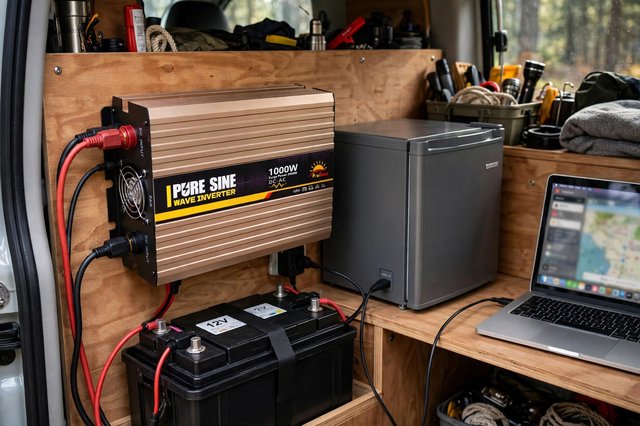
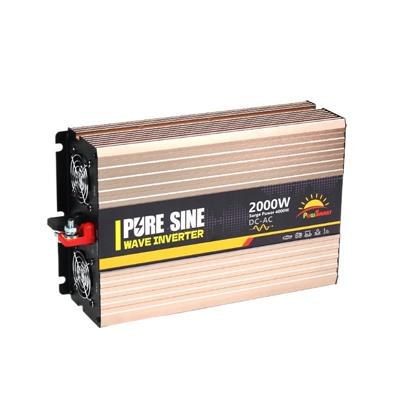
The 3000W model is the next step up from the 2000W model we covered yesterday, and the difference is one appliance class: the microwave line.
| REP2000 | REP3000 | |
|---|---|---|
| Rated power | 2000W | 3000W |
| Peak power | 4000W | 6000W |
| Microwave | Compact models only, check the plate | 1000–1200W listed on the product page |
| Washing machine / small air conditioner | Not listed | Listed, with surge check against 6000W peak |
The two models share the same protection voltages and efficiency, so the choice is purely about your load list. If your list stays under 2000W continuous and no single start-up surge comes near 4000W, the 2000W model is enough. If a 1000–1200W microwave, a washing machine or a small air conditioner is on the list, that is where the extra 1000W rated and 2000W peak earn their keep.
How to Size a 3000W Inverter in Three StepsStep 1 — List every appliance you want to run at the same time, with the running watts from each rating plate. The plate, not the marketing label, is the number that counts.
Step 2 — Add the start-up surge. Motors and compressors draw roughly two to three times their running watts briefly at switch-on. Add the largest single surge to your running total and check it against the 6000W peak.
Step 3 — Leave headroom. If your running total is above about 2400W, or your worst surge is near 6000W, choose the next size up — the REP range continues to 4000W and 5000W models.
12V, 24V or 48V — Which Version?Match the battery system you already have. The REP3000 comes in 12V, 24V and 48V versions (REP3000-121/122, -241/242 and -481/482), with 110V or 220V output at 50Hz or 60Hz. The difference that matters most is current: at 3000W, a 12V battery has to deliver roughly 278A, while a 48V system delivers the same power at about a quarter of that current, with higher efficiency — up to 90% at 12V, 92% at 24V and 95% at 48V (product page figures). For a new installation, 24V or 48V is better: thinner cables, less heat. On 12V, keep DC cables short and thick and follow the manual for cable and fuse sizing.
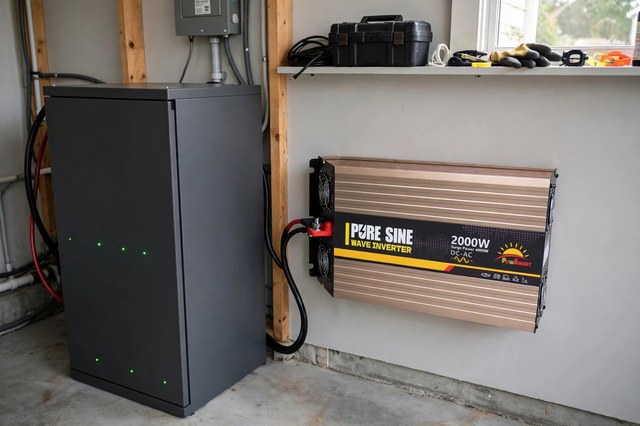
The REP3000 protects itself and your battery with set voltage points (product page, 12V / 24V / 48V models):
| Setting | 12V model | 24V model | 48V model |
|---|---|---|---|
| Low-voltage alarm | 10.5±0.5V | 21±0.5V | 42±1V |
| Low-voltage protection (shut-off) | 10±0.5V | 20±0.5V | 40±0.5V |
| Low-voltage recovery | 12.3±0.5V | 24±0.5V | 48±1V |
| Over-voltage protection | 15.5±0.5V | 31±0.5V | 61±1V |
| Over-voltage recovery | 14.8±0.5V | 29.5±0.5V | 48±1V |
Note the 48V column: only the low-voltage protection itself is ±0.5V — the alarm, recovery and over-voltage figures are ±1V. The unit also protects against overload, over-temperature, short circuit and input reverse polarity (the fuse burns out). Working temperature is -10 to 50°C. If the inverter alarms or shuts down on low voltage, check the battery first — a low battery sags under load before the inverter is at fault. See our inverter shutdown checklist for the five checks in order.
Wiring and Cooling: What to Get RightThree points decide whether a 3000W inverter runs quietly or trips: short, thick DC cables (278A on 12V punishes thin or long runs); a fuse sized to the manual, fitted close to the battery; and airflow — the fan needs clear intake and exhaust, so do not box the unit into a sealed cabinet or park it in direct sun. The unit weighs 4.95 kg net and ships in a 453×252×150mm box, and has a 5V USB charging port (QC3.0 on 12V and 24V models; not fitted on 48V).
When 3000W Is Not EnoughIf your list needs more than 3000W continuous — a microwave plus a kettle plus a fridge all at once, or a larger air conditioner — step up to the 4000W or 5000W models in the REP pure sine wave series. If your loads are small — lights, laptop, phones and a small fridge — a 1000W or 2000W model may be enough and will draw less at idle (no-load current under 1A at 12V). The REP3000 is an inverter only and does not charge the battery; if you need mains charging, ask about the inverter-with-charger (UPS) models.
Yes — a 1000–1200W microwave is listed on the REP3000 product page. Check the input watts on its rating plate (input watts are higher than cooking watts), keep the total running load under 3000W and the surge under the 6000W peak.
Possibly. The product page lists a small air conditioner, but only with a check first: read the rating plate for running watts and start-up surge and compare the surge with the 6000W peak.
Match your battery. At full load, 12V draws roughly 278A; 24V draws about half that, and 48V about a quarter.
It depends on battery capacity, not on the inverter. Divide usable battery watt-hours by load watts: a 48V 100Ah battery holds about 4800Wh in theory, so a 1200W load runs about 4 hours before losses. Usable capacity depends on battery type and depth of discharge.
No. It is an inverter only, converting DC to AC. If you need mains charging in the same unit, ask about the inverter-with-charger (UPS) models. Full specifications are on the REP3000 product page.
Still unsure which size fits your load list? Contact Sunrise New Energy for sizing help — tell us your appliances and battery voltage. Zhejiang Sunrise New Energy Co., Ltd. builds pure sine wave inverters from 300W to 5000W, plus inverter PCBA boards for OEM integration.

We use cookies to enhance your browsing experience, serve personalized ads or content, and analyze our traffic. By clicking "Accept All", you consent to our use of cookies.