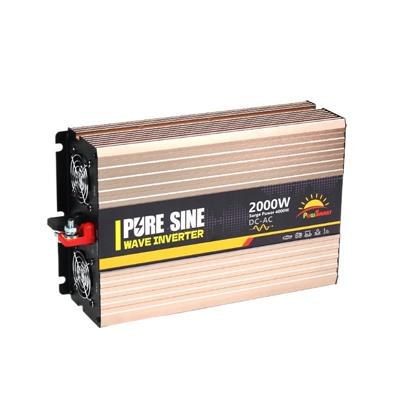
A 2000W pure sine wave inverter runs a fridge, TV, lights and a laptop at the same time, or a single 1800W kettle on its own, with 4000W of peak power for motor start-up. This guide explains what the Sunrise New Energy (Powsmart) REP2000 can and cannot run, and how to size one from your own load list.
What Can a 2000W Inverter Run?The REP2000 is rated 2000W continuous and 4000W peak, with a pure sine wave output (THD below 3% under linear load) — the same waveform quality as household mains, safe for laptops, TVs and other sensitive electronics. The product page lists three typical sets: a fridge with lights and a TV, an 1800W kettle on its own, or power tools on site. The rule is simple: keep total running watts under 2000W, and any brief motor start-up surge under 4000W.
Typical running watts for everyday loads:
Add up a realistic evening set: a fridge at 150W, a TV at 120W, four LED lights at 40W, a laptop at 90W and chargers at 20W — 420W running, about one fifth of the rated output. Even when the fridge compressor kicks in, the surge stays well inside the 4000W peak.
It will not run several high-power appliances at once — a kettle, a microwave and a heater together exceed 2000W continuous — and a large air conditioner or full-size water heater is beyond it. If your list is close to 2000W continuous, or a motor needs more than 4000W to start, step up a size (see below).
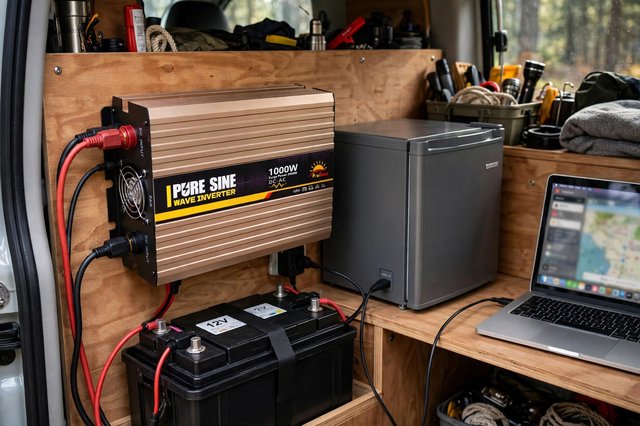
Step 1 — List every appliance you want to run at the same time, with the running watts from each rating plate. The plate, not the marketing label, is the number that counts.
Step 2 — Add the start-up surge. Motors and compressors (fridge, air conditioner, power tools) draw several times their running watts briefly at switch-on. Add the largest single surge to your running total and check it against the 4000W peak.
Step 3 — Leave headroom. If your running total is above about 1600W, or your worst surge is near 4000W, choose the next size up — an inverter run near its limit all day runs hotter and louder.
12V, 24V or 48V — Which Version?Match the battery system you already have. The REP2000 comes in 12V, 24V and 48V versions (models REP2000-121/122, REP2000-241/242 and REP2000-481/482), with output in 110V or 220V ranges. The difference that matters most is current: at 2000W, a 12V system draws over 180A from the battery at full load, while a 48V system draws about a quarter of that, with higher efficiency — 90% at 12V, 92% at 24V and 95% at 48V (product page figures). For a new solar or backup installation, 24V or 48V is better: thinner cables, less heat, cooler running. On 12V, keep DC cables short and thick and follow the manual for fuse sizing.
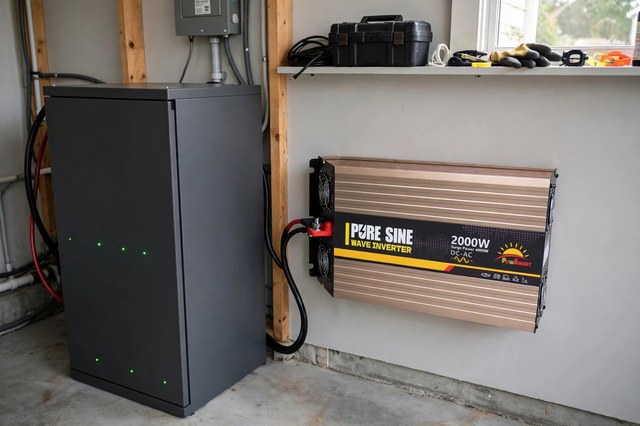
The REP2000 protects itself and your battery with set voltage points (product page, 12V / 24V / 48V models):
| Setting | 12V model | 24V model | 48V model |
|---|---|---|---|
| Low-voltage alarm | 10.5±0.5V | 21±0.5V | 42±1V |
| Low-voltage protection (shut-off) | 10±0.5V | 20±0.5V | 40±0.5V |
| Low-voltage recovery | 12.3±0.5V | 24±0.5V | 48±1V |
| Over-voltage protection | 15.5±0.5V | 31±0.5V | 61±1V |
| Over-voltage recovery | 14.8±0.5V | 29.5±0.5V | 59±1V |
It also protects against overload, over-temperature, short circuit and input reverse polarity, and cools itself with an intelligent fan. Working temperature is -10 to 50°C. If the inverter alarms or shuts down on low voltage, check the battery state of charge first — a low battery sags under load before the inverter is at fault. Our inverter shutdown checklist walks through the five checks in order.
Wiring and Cooling: What to Get RightThree installation points decide whether a 2000W inverter runs quietly or trips: short, thick DC cables (high current on 12V punishes thin or long runs); a fuse sized to the manual, fitted close to the battery; and airflow — the fan needs clear intake and exhaust, so do not box the unit into a sealed cabinet or park it in direct sun. The unit measures 355 x 205 x 95 mm and weighs 3.9 kg net, so check the mounting space in your RV, truck or cabinet before ordering. It also has a 5V USB charging port (QC3.0 on the 12V and 24V models; not fitted on 48V models).
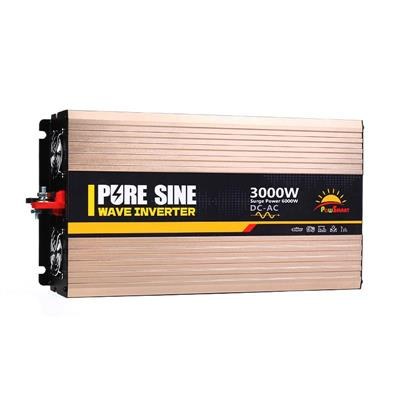
When 2000W Is Not EnoughIf your list needs more than 2000W continuous — a 1000–1200W microwave plus a fridge, a washing machine, or a small air conditioner — step up to the REP3000: rated 3000W with 6000W peak, and its product page lists exactly those loads. If your loads are small — lights, laptop, phones and a small fridge — a 1000W model may be enough and will draw less at idle (no-load current on the REP2000 is under 0.9A at 12V). The right size is the smallest one that covers your real list with headroom.
Yes. A typical fridge runs at 100–150W, and its compressor start-up surge fits inside the 4000W peak. Keep your other simultaneous loads under the 2000W continuous rating.
Possibly, if it is compact. Check the microwave input watts on its rating plate (input watts are higher than cooking watts) and add them to your other loads — the total must stay under 2000W continuous and the surge under 4000W peak. The 3000W model is the one listed for 1000–1200W microwaves.
Match your battery. At full load 12V draws over 180A; 24V and 48V draw about half and a quarter of that. For new installations, 24V or 48V is preferred.
It depends on battery capacity, not on the inverter. Divide usable battery watt-hours by load watts: a 12V 200Ah battery holds about 2400Wh in theory, so a 400W load runs about 6 hours before inverter and battery losses. Usable capacity depends on battery type and depth of discharge, so treat it as an estimate.
No. It is an inverter only, converting DC to AC. If you need mains charging in the same unit, ask about the inverter-with-charger (UPS) models. Full specifications are on the REP2000 product page, and the whole range is on the REP series page.
Still unsure which size fits your load list? Contact Sunrise New Energy for sizing help — tell us your appliances and battery voltage, and we will match a model from the REP pure sine wave series. Zhejiang Sunrise New Energy Co., Ltd. builds pure sine wave inverters from 300W to 5000W, plus inverter PCBA boards for OEM integration.

We use cookies to enhance your browsing experience, serve personalized ads or content, and analyze our traffic. By clicking "Accept All", you consent to our use of cookies.