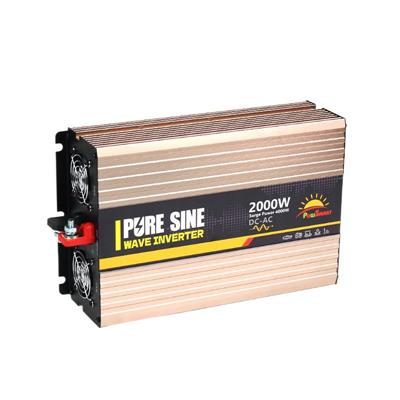
Yes — you can run most corded power tools from a work van if you choose a pure sine wave inverter sized for the tool's starting surge, not just its running watts. For a single drill, impact driver charger or small circular saw, most tradespeople need a 1500W to 3000W continuous inverter wired directly to the battery with short, thick cables. Size it correctly and your van becomes a quiet, mobile job-site power source.
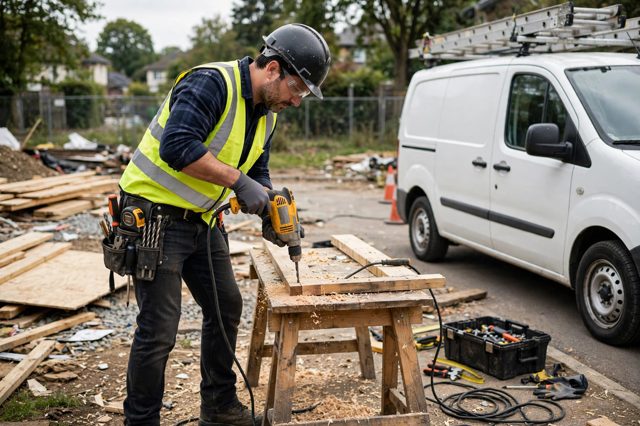
What power tools can a work van inverter actually run?Start by listing the tools you really use on site, one at a time. Battery-tool chargers are the easiest load — most draw only 100W to 350W while charging. Corded drills typically run at 500W to 800W, angle grinders at 800W to 1200W, and circular saws at 1200W to 1800W. Heat guns, site lights and small vacuums sit in the same range. The golden rule is simple: run one large tool at a time, and let chargers and lights share what is left.
Add up the running watts of everything you plan to use at the same moment — not everything in the van. If a saw (1500W) and a work light (100W) run together, you need at least 1600W continuous, before surge. That single calculation prevents most overload shutdowns.
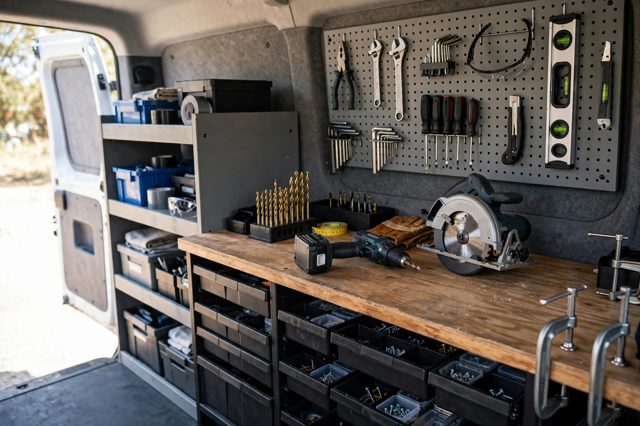
Tools with motors do not start gently. A circular saw or grinder can draw two to three times its rated power for a fraction of a second when the trigger is pulled. An inverter that matches only the running watts will trip on overload every time the tool starts.
Choose an inverter whose continuous rating covers your combined running load, and whose peak rating covers the largest tool's starting surge. In practice, that means stepping up one size: a 2000W continuous inverter for a 1200W saw, or a 3000W unit if you also charge batteries at the same time. Pure sine wave output matters here too — brushless and variable-speed tools with electronic controls run cooler, quieter and more reliably on a clean sine wave than on a modified wave.
12V or 24V: which system fits a work van?Most vans have a 12V starter battery system, so a 12V inverter is the straightforward choice up to about 2000W. Above that, current gets very high: 3000W at 12V can pull well over 250A from the battery, which demands very thick cables and perfect connections.
If your van or truck already has a 24V system, or you plan a separate auxiliary battery bank for all-day work, 24V halves the current for the same power and makes a 3000W setup far more practical. For daily heavy tool use, an auxiliary battery — charged while driving — protects your starter battery and is the professional setup. Never rely on the starter battery alone for long jobs with the engine off.
Mount the inverter close to the battery and use the cable gauge the manual specifies for your power level and cable length. Undersized or long cables cause voltage drop, heat and nuisance shutdowns under load — the most common cause of 'weak' inverter performance on site.
Install a fuse or breaker rated for the inverter's maximum DC current, placed near the battery terminal. It protects the cable run through the van body, where chafing is a real risk. Route cables through grommets, secure them against vibration, and keep the inverter's vents clear so cooling air can flow while a saw is working hard.
Follow the manufacturer's grounding instructions, and never enclose a hard-working inverter in an airtight box. Heat builds quickly at 2000W and above, and thermal shutdown in the middle of a cut helps no one. A ventilated, dry mounting spot away from fuel and water is the right home.
How long can you work before the battery goes flat?Runtime is simple maths: a 12V 100Ah auxiliary battery stores about 1200Wh, and you should use only part of it to protect battery life. At a steady 1000W load, expect roughly half an hour to an hour of real work once inverter losses and battery limits are counted. Charging tool batteries uses far less energy, so chargers can run for hours.
For half-day or full-day sites without mains power, pair the inverter with a larger auxiliary battery bank and recharge by driving or from solar. Running the engine during very heavy, short loads is also a practical way to support the battery — but plan the system so the engine is a backup, not the plan.
Yes, if the inverter's continuous and peak ratings cover the saw. Larger saws often need a 3000W or higher pure sine wave inverter and a battery bank that can deliver the current. Test your exact saw before relying on it on site.
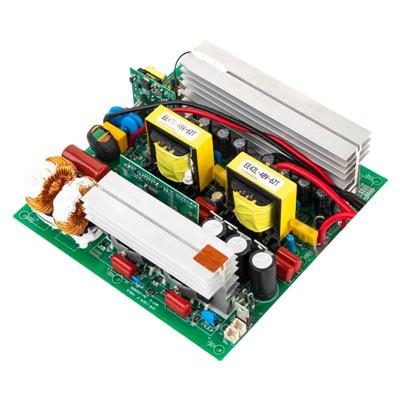
A quality pure sine wave inverter produces power similar to mains electricity and is the safe choice for modern tools, chargers and electronics. Avoid modified sine wave models for variable-speed and brushless tools.
Yes — just add the charger's watts to the tool's running watts and stay within the inverter's continuous rating. If the total is close to the limit, charge after the cut, not during it.
For light, occasional use, usually not. For a large auxiliary bank recharged daily, a DC-to-DC charger sized to your alternator is the controlled, battery-friendly way to refill the bank while driving.
The bottom line for tradespeopleList your tools, add surge headroom, choose pure sine wave, and wire it properly — that is the whole recipe for reliable power tools in a work van. A 1500W to 3000W inverter with an auxiliary battery covers the great majority of trade work, from charging every battery on the drive over to cutting timber on a site with no mains at all.
Not sure which size fits your tool list and van? Send us your tools, your van's battery setup and how long you work on site, and Zhejiang Sunrise New Energy Co., Ltd. will help you select the right inverter system. Visit cninverter.com to contact our team for a practical, no-obligation sizing recommendation.

We use cookies to enhance your browsing experience, serve personalized ads or content, and analyze our traffic. By clicking "Accept All", you consent to our use of cookies.