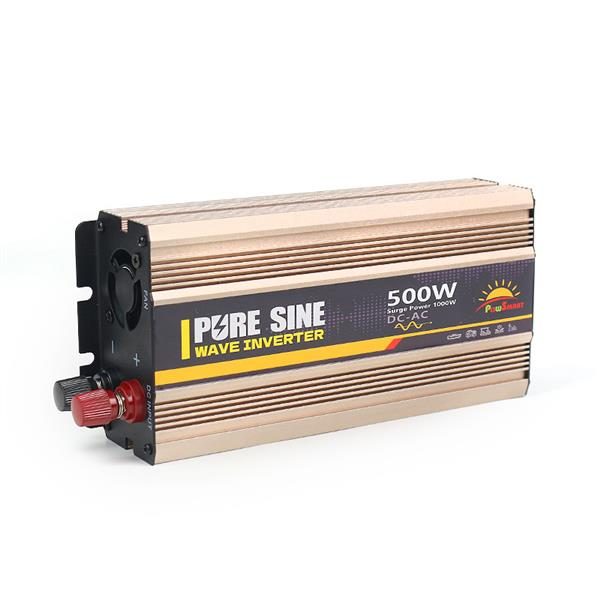
Tesla's new vehicle-to-load (V2L) feature is limited to 2027 model-year cars, so owners of older Tesla cars — and every petrol, diesel, truck and RV driver — still need a standalone inverter to get AC power from a vehicle. The China version is rated at 2.2kW at 220V, and the US Powershare version is capped at 2.4kW at 120V through an adapter. This guide from Zhejiang Sunrise New Energy Co., Ltd. explains what was announced, where V2L stops, and how to size a standalone inverter instead.
What Did Tesla Announce About V2L?Tesla added V2L to the 2027 Model 3 for China, South Korea, Australia and New Zealand, and on October 6 Tesla Energy expanded V2L and Powershare home backup to Model 3 and Model Y in the United States. In China, the system supplies 2.2kW at 220V and 10A through a separate discharge adapter fitted to the charging port. Media reports put that adapter at 599 yuan in China, sold separately.
In the United States, the adapter-based output is reported at up to 2.4kW at 120V — enough for a refrigerator, lights, a rice cooker and most campsite equipment. Drivers increasingly expect a car to work as a mobile power source, not only as transport.
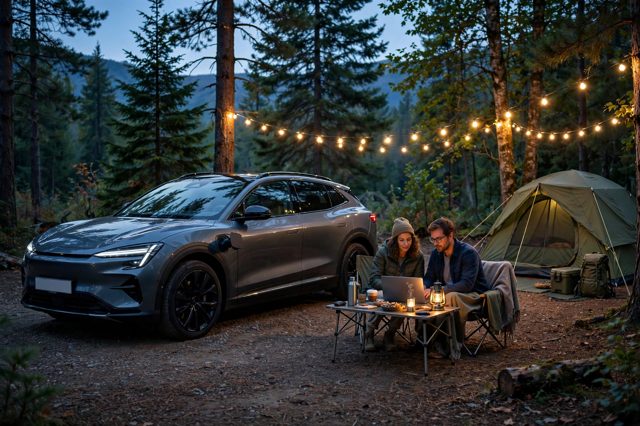
V2L is useful where it exists, but it has three hard limits that no software update can remove.
V2L depends on hardware fitted to 2027 model-year cars. Cars already sold cannot gain it through a software update or a retrofit. That matters because the existing fleet is large. An owner who bought a Model 3 or Model Y before the 2027 model year, however recent the purchase, is outside the feature.
The car does not provide a household socket on its own; power comes through an adapter that must be bought separately and carried with the car. Lose it, leave it at home, or drive a different vehicle, and the AC output goes with it. A standalone inverter, by contrast, can move between vehicles and a home backup setup.
A 2.2kW ceiling covers many small and medium loads, but it will not comfortably run larger appliances such as a household air conditioner alongside other loads. Motor and compressor starting surges make the limit tighter in practice. Drivers who need more continuous power, or power for longer periods without spending driving range, need a different plan.
Who Still Needs a Standalone Inverter?Anyone whose vehicle does not offer V2L today — which is still most vehicles on the road — needs a standalone inverter for vehicle AC power.
Owners of pre-2027 Model 3 and Model Y cars are the clearest group. Their cars have no V2L hardware, and that will not change. A correctly sized inverter on a suitable 12V system, used within the maker's limits, or on a separate auxiliary battery, gives them campsite, work and emergency power without changing the car.
A fuel-powered car has no traction battery and no V2L, but its 12V battery and alternator can run an inverter for laptops, lights, travel fridges, small tools and emergency charging. For these drivers, an inverter is not a second choice; it is the only route to AC power from the vehicle.
Many electric cars from other brands, and many older models, were sold without vehicle-to-load. A standalone inverter paired with an auxiliary battery gives their owners outage and campsite power without drawing on the system the car needs to start and drive.
Trucks and RVs often need power for many hours, from a house battery rather than the starting battery. A dedicated battery plus an inverter sized for the job keeps a fridge, microwave, TV and tools running overnight, and can be sized for the trip rather than fixed at 2.2kW.

Size an inverter from a written load list: add the running watts of everything used at the same time, allow headroom for starting surges, and choose pure sine wave output.
First, list the loads. Phones and LED lights may total under 50W, a laptop 60–100W, a travel fridge roughly 50–100W while running, and kettles, coffee machines, microwaves and power tools often 1,000W or more. Your simultaneous total sets the minimum continuous rating. Standalone inverters are available across a wide range, from about 300W for light charging to 6,000W for large vehicle and backup systems, so the size can follow the job.
Second, allow for surge. Motors and compressors draw several times their running power for a moment at start-up. Choose an inverter whose surge rating covers your largest motor starting while other loads are already running.
Third, choose pure sine wave. Modern chargers, fridges, electronics and tools are designed for the clean waveform the grid provides. For sensitive or motor loads, pure sine wave is the safe default.
Fourth, match the battery and wiring. A 12V system suits cars and smaller loads; 24V is common in trucks. Heavy loads need direct battery connections, correctly sized cables and fusing — never a cigarette-lighter socket — and long use belongs on an auxiliary battery.
Can I add Tesla V2L to an older Model 3 or Model Y?
No. V2L on these cars is 2027 model-year hardware and cannot be added by software or retrofit. The practical alternative is a standalone inverter on a suitable battery system.
Is a standalone inverter better than V2L?
For a 2027 car owner who already has V2L, the built-in feature is convenient for occasional use up to its limit. A standalone inverter is better when your car lacks V2L, when you need more than about 2.2kW, when you need power away from that one car, or when you do not want to spend driving range.
What size inverter do most drivers need?
For lights, phones and a laptop, 300W to 500W is often enough. For a fridge, TV and small tools, many drivers choose 1,000W to 2,000W. For kettles, microwaves or larger tools, 2,000W to 3,000W or more may be needed, subject to battery, cable and surge checks. Start from your load list, not from the largest rating available.
Start With the Car in Your DrivewayThe deciding question is not whether V2L is a good feature — it is. The question is whether the car you own today actually has it. If you drive a 2027 car with V2L, use it within its 2.2kW or 2.4kW limit. If you drive an older Tesla, a petrol or diesel car, an older EV, a truck or an RV, a correctly sized pure sine wave inverter gives you AC power now, in the vehicle you already have.
Zhejiang Sunrise New Energy Co., Ltd. supplies pure sine wave inverters and vehicle power systems for cars, trucks and RVs. Tell us your vehicle, battery voltage and the appliances you want to run, and we will recommend the right size. Visit cninverter.com or contact us: WhatsApp 86 17706649699, email Long@cninverter.com.

We use cookies to enhance your browsing experience, serve personalized ads or content, and analyze our traffic. By clicking "Accept All", you consent to our use of cookies.